
To split bills based on income, add both incomes together, then each person pays the same percentage of every shared bill as their share of that total. If you earn $8,000 a month and your partner earns $5,000, you bring in 62% of the household income, so you pay 62% of the rent and bills and your partner pays 38%. Our free calculator below does the math for you.
Free split-bills-by-income calculator
Enter both incomes and your shared expenses, and the calculator shows what each of you pays.
Open the free calculator (Google Sheets)
- Open the link above.
- Click File > Make a copy so you have your own editable version.
- Add your names, monthly incomes and shared expenses. The percentages and amounts update automatically.
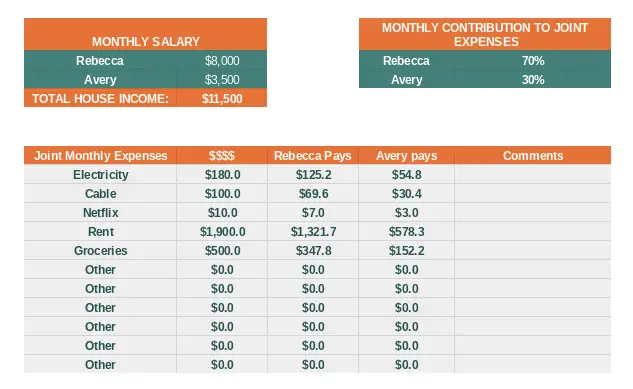
The formula
- Add both incomes: Person A + Person B = total income
- Divide each income by the total: Person A ÷ total = Person A’s share
- Multiply each shared bill by each person’s share.
Example
Rebecca earns $8,000 a month and Avery earns $5,000. Their rent is $4,000.
- Total income: $8,000 + $5,000 = $13,000
- Rebecca’s share: $8,000 ÷ $13,000 = about 62%
- Avery’s share: $5,000 ÷ $13,000 = about 38%
- Rent: Rebecca pays about $2,480 and Avery pays about $1,520.
Why split by income instead of 50/50?
Look at what each person has left after rent:
| 50/50 split | Split by income | |
|---|---|---|
| Rebecca pays | $2,000 | $2,480 |
| Avery pays | $2,000 | $1,520 |
| Rebecca has left | $6,000 | $5,520 |
| Avery has left | $3,000 | $3,480 |
With a 50/50 split, the lower earner gives up a much bigger piece of their paycheck and has less left for savings, debt and their own goals. Splitting by income means you both give up the same percentage, and the higher earner still keeps more money.
It also lets a couple afford a nicer place together. Most landlords use the 3 times rent rule, and many let you combine incomes to qualify. A 50/50 split would cap your rent at what the lower earner can afford.
When 50/50 makes more sense
- Roommates and friends. Splitting rent evenly, or by room size, is usually simpler and fairer. Income-based splits are mainly for couples sharing finances and goals.
- Incomes that are close. If you earn about the same, 50/50 is nearly identical and easier.
- When you’d rather not share income details. Splitting by income only works if you’re both open about what you earn.
Tips for splitting expenses as a couple
- Agree on what counts as shared. Rent, utilities, internet, groceries and renter’s insurance usually do. Gym memberships, hobbies and personal shopping usually don’t.
- Decide how to handle debt. Some couples subtract student loan or other required debt payments from each income before calculating percentages. For a cautionary story about getting this wrong, read this account in The Financial Diet.
- Use a joint account for shared bills. Each of you transfers your percentage every payday, and all shared bills come out of that account.
- Or split by bill. If one person owes about 35% of everything and the utilities and groceries add up to about 35%, that person can just pay those while the other pays rent. It saves a lot of transfers.
- Revisit it when things change. A raise, job loss or new baby is a good time to recalculate.
- Remember the lease. If you’re both on the lease, the landlord can usually hold either of you responsible for the full rent, no matter how you split it between yourselves.
Related guides: How Many People Can Live in a 2-Bedroom Apartment and Where to Get Quarters for Laundry.
FAQ
Should couples split bills based on income?
It’s a personal choice, but many couples find it fairer and less stressful than 50/50, especially when one person earns a lot more. Try it for a month or two and see how it feels.
How do you split bills if you make more?
You pay the same percentage of each bill as your share of your combined income. In the example above, the person earning 62% of the income pays 62% of each shared bill.
Is splitting bills by income the same as splitting 50/50 of what’s left?
No. Splitting by income means you each pay the same percentage of your own income. You can also aim to have equal money left over, but that has the higher earner paying much more, and fewer couples choose it.

I’m so confused! In your example above you have Rebecca paying 38% of the bills while Avery pays a whopping 62%, despite Rebecca earning $36k a year more than Avery. Who in earth would the spouse with the smaller income be forced to pay nearly two-thirds of their total monthly expenses?
Hello Renee,
You are right, we mixed the amounts but it is now fixed.
Thanks for letting us know!
That’s great for 2 people, was wondering how to do the calculations for 3+ people.